

Data Quality Management in SAP: A Practical Guide for S/4HANA Migration Teams
This guide focuses on how to manage SAP data quality operationally and which approach to choose — not a broad overview of the migration process.
For that, read our guide to SAP data migration:
https://taleofdata.com/blog/sap-data-migration
Quick answer
|
Data quality management in SAP is the process of profiling, validating, remediating, and documenting SAP master data before it enters S/4HANA. For migration teams, the critical work happens in the staging layer — where ECC extracts can be deduplicated, enriched, validated by business owners, and traced before SAP Migration Cockpit load. SAP MDG and SAP data quality management capabilities are valuable inside the SAP governance ecosystem, but migration teams often still need a dedicated staging-layer workstream to profile, deduplicate, remediate, validate, and document legacy ECC data before S/4HANA load. |
If you are reading this, you already know that data quality is a problem in your SAP migration project.
The question is no longer whether it matters — it is how to manage it operationally: where the work happens, who validates the corrections, which tools are suited for what, and how to avoid arriving at cutover with data that generates errors in S/4HANA from day one.
This guide covers the practical side of data quality management in SAP S/4HANA migration projects: what it actually means for migration teams, where SAP MDG and SAP data quality management capabilities fit — and where they do not cover the full pre-migration workstream — and how to build a structured data quality process in the staging layer before S/4HANA load.
What this article covers
- What data quality management SAP actually means for migration teams — beyond governance theory
- Where SAP MDG, SAP data quality management capabilities, and the SAP Migration Cockpit each fit — and their limits before migration
- The 4 data quality dimensions that most frequently block S/4HANA migrations
- The 3 approaches to SAP data quality management before cutover — with a clear comparison
- A practical 3-step process: profile, validate, and remediate staging data before Migration Cockpit load
- How Tale of Data supports SAP data quality management in the staging layer
- When to use Tale of Data vs SAP MDG for each phase
What Data Quality Management in SAP Actually Means for Migration Teams
Data quality management in SAP projects is frequently equated with SAP MDG or SAP data quality management tools.
These are powerful capabilities — but they are primarily governance tools, designed to sustain data quality inside the SAP ecosystem over time.
For migration teams, data quality management means something more operational: identifying problems in legacy data before they enter the target system, getting the right people to validate corrections, applying those corrections in a controlled environment, and documenting every change for audit purposes.
It is not just about correcting errors. It is about building a process that can run repeatedly — through profiling cycles, business validation rounds, and re-checks — until the staging data meets the quality thresholds required for SAP Migration Cockpit load.
This process does not replace SAP governance. It precedes it.
SAP data quality management: the 4 operational components
| Component | What it means |
|---|---|
| Profiling | Automated scanning of ECC extracts to identify duplicates, completeness gaps, consistency errors, and inactive records in the staging layer |
| Business validation | Review and approval of correction decisions by domain owners from procurement, finance, and operations |
| Remediation | Applying corrections in the staging layer in a no-code or low-code environment accessible to business teams without IT bottlenecks |
| Lineage | Automatic documentation of every correction with its source, rule, responsible owner, and timestamp, for audit compliance |
SAP data quality management identifies data issues before migration. The staging layer is where ECC data is profiled and remediated. Business owners validate corrections before data enters S/4HANA. Correction lineage documents what changed, why, by whom, and when.
SAP MDG, SAP Data Quality Management Capabilities, and Migration Cockpit: Where Each One Fits
Understanding what each SAP tool does — and what it is not designed for — is the starting point for any realistic data quality management strategy before S/4HANA cutover.
|
Component |
Main role |
Best suited for |
Limit before migration |
|
SAP Migration Cockpit |
Technical migration and load |
Moving prepared data into S/4HANA |
Does not remediate upstream business data quality issues |
|
SAP MDG |
Master data governance |
Ongoing governance, workflows, and standards after go-live |
Can be heavy to deploy solely for short-term pre-migration cleansing |
|
SAP data quality management capabilities / SAP DQM |
Rules, checks, and monitoring within SAP MDG / S/4HANA |
Embedded SAP governance and quality controls |
May not cover external staging-layer profiling and no-code business remediation needs |
|
Tale of Data |
No-code data quality in the staging layer |
Profiling, deduplication, remediation, business validation, and lineage before cutover |
Complements SAP — does not replace SAP governance or Migration Cockpit |
SAP’s data quality management capabilities — often referred to as SAP DQM in this context — are delivered within the SAP Master Data Governance environment on SAP S/4HANA. They provide validation rules, standardization, quality monitoring, and rule-based checks for Products and Business Partners. These capabilities require SAP MDG to be deployed and configured to be used at scale.
SAP MDG is designed for ongoing master data governance — central or decentralized workflows, change request management, data distribution, and quality monitoring across the SAP landscape.
SAP MDG can support master data quality and governance, especially as an ongoing governance layer. But migration teams often need a faster, project-oriented way to profile and remediate legacy data in the staging layer before S/4HANA load — without the lead time and complexity of a full MDG deployment.
SAP Migration Cockpit supports the transfer of prepared migration objects into S/4HANA and performs technical checks during the load process. Project teams remain responsible for ensuring that the data in staging is accurate, complete, deduplicated, and business-approved before the Cockpit processes it.
Need to understand where your SAP data quality risks are?
The Tale of Data Flash Audit profiles your staging extract in just a few clicks, helping you identify Business Partner duplicates, missing CVI fields, material inconsistencies and financial data gaps before cutover.
It delivers a prioritized risk report depending on data access and scope — with no access to your production SAP system required.
The 4 Data Quality Dimensions That Matter Most in SAP Migration
In a migration context, SAP data quality does not need to be perfect everywhere. It needs to be sound on the dimensions that can block cutover or create operational risk after go-live.
1. Uniqueness — Business Partner deduplication
SAP S/4HANA unifies customers and vendors under the Business Partner object via CVI. Duplicate customer or vendor records in ECC can create load errors or structural duplicates in the Business Partner model — issues that are significantly harder to resolve after go-live.
Fuzzy matching across name variants, address forms, and legal entity types is required before extraction.
2. Completeness — mandatory CVI fields and Material Master views
CVI requires fields that ECC did not enforce as mandatory: BP category, BP grouping, country, and tax scheme. Records missing these fields may trigger errors during Migration Cockpit load.
Similarly, S/4HANA activates mandatory Material Master views depending on the target configuration.
3. Consistency — units of measure, chart of accounts, cross-entity coherence
S/4HANA validates unit of measure consistency at record creation. GL accounts with different names or assignments across entities create consolidated reporting inconsistencies in the Universal Journal from the first posting after go-live.
4. Traceability — correction lineage for audit compliance
SAP migration audit requirements call for documented controls confirming the completeness and accuracy of data moved from ECC to S/4HANA.
Every remediation decision must be traceable with its source, rule, owner, and date. Correction lineage generated automatically by the remediation tooling is the only scalable way to meet this requirement.
The 3 Approaches to SAP Data Quality Management Before Cutover
Migration teams typically choose between three approaches to manage data quality before cutover. Each has genuine strengths and real limitations for staging-layer preparation.
|
Approach |
Strengths |
Limitations for pre-migration data quality |
|
SAP integrator / scripts / BODS / SQL |
Fast for technical fixes; integrated to project; covers specific ETL transformations |
IT-dependent; limited business team access; auditability varies; one-shot logic with no collaborative validation workflow |
|
SAP MDG / SAP data quality management capabilities |
Strong for SAP governance; consistent with SAP ecosystem; valuable for ongoing post-go-live master data management |
Deploying MDG solely for short-term pre-migration cleansing can be disproportionate; requires SAP expertise and dedicated configuration |
|
Dedicated no-code data quality platform (e.g. Tale of Data) |
Connects to staging layer; automated profiling; fuzzy matching; no-code business validation; automatic lineage; results in weeks |
Complements SAP — does not replace post-migration governance |
For migration teams, the best approach is often not to choose between SAP tools and a dedicated data quality platform. It is to use each layer for what it does best: SAP for governance and migration load, Tale of Data for upstream staging data quality.
A Practical SAP Data Quality Management Process Before Cutover
Regardless of the tooling chosen, a structured data quality management process before S/4HANA cutover follows three sequential steps.
Step 1 — Profile the staging extract
Before any correction decision is made, run automated profiling on the ECC extract loaded into the staging layer.
The output should identify:
- Duplicate Business Partner candidates — same supplier or customer represented multiple times
- Missing mandatory CVI fields — BP category, BP grouping, country, tax scheme — by record and domain
- Inconsistent material attributes — unit of measure conflicts, missing Material Master views
- Inactive or obsolete records — materials and organizational units with no recent transactions
- Invalid financial references — inactive cost centers or profit centers in substitution rules
The profiling output is the foundation for every correction decision that follows. Without it, business validation is guesswork.
Step 2 — Validate with business owners
The profiling output identifies correction candidates — but the decision authority rests with domain owners.
Procurement validates supplier merges, finance validates GL account mapping, operations validates material scope, and MDM leads validate cross-role Business Partner assignments.
The bottleneck in most migration data quality projects is not technical — it is the time required to get business teams to review and approve corrections.
A no-code environment compresses the remediation timeline significantly.
Step 3 — Remediate, document, and re-check
Corrections are applied in the staging layer.
Every correction is documented with its source, rule, responsible owner, and date — automatically, not in a manual spreadsheet.
The profiling run re-executes on the corrected data to confirm that quality thresholds are met.
The output is not just clean data — it is clean, documented, and auditable data. The correction lineage is the evidence that internal controls and external auditors require to sign off on the migration.
For the 10 operational checks to validate before cutover, read our guide to
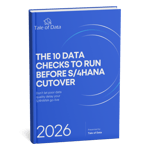
→ SAP data migration best practices
Ready to start profiling your staging data before cutover?
The Tale of Data Flash Audit connects to your staging environment and profiles your data in just a few clicks to identify Business Partner duplicate rates, completeness gaps, consistency issues and governance flags before cutover.
It delivers a prioritized data quality risk report based on data access and scope — with no access to your production SAP system required.
How Tale of Data Supports SAP Data Quality Management
Tale of Data is an AI-powered no-code data quality platform built to help data and business teams profile, remediate, validate, and document data quality issues at scale.
In the context of SAP data quality management, it addresses the staging-layer workstream before SAP Migration Cockpit load.
Tale of Data does not replace SAP Migration Cockpit, SAP MDG, or the role of your SAP integrator. Its role is the preparation phase: profiling, remediating, validating, and documenting the quality of staging data before it enters S/4HANA.
|
Migration challenge |
How Tale of Data helps |
|
Duplicate customers and vendors |
Fuzzy matching (Levenshtein, Jaro-Winkler, phonetic) across name variants, addresses, legal entity types — before extraction |
|
Missing mandatory CVI fields |
Automated profiling identifies completeness gaps by domain and flags records before Migration Cockpit load |
|
Inconsistent material attributes |
Cross-entity consistency checks across plants and company codes — units of measure, material views, valuation data |
|
Business validation bottleneck |
No-code environment for procurement, finance, and operations teams to validate corrections without SQL or IT dependency |
|
Audit trail requirements |
Every correction documented with source, rule, responsible owner, and timestamp — generated automatically, not manually |
|
IT dependency for corrections |
Business teams apply remediation decisions directly, without writing SQL queries or waiting for development cycles |
In a typical SAP migration project, Tale of Data connects to the staging environment via JDBC — Oracle, SQL Server, Snowflake, Databricks — and profiles the extracted ECC datasets before they are loaded into S/4HANA.
Business teams access a no-code environment to review duplicate candidates, validate merge decisions, complete missing fields, and flag inactive records. Every correction is automatically traced, producing the documentation required for audit sign-off.
What Tale of Data does not do
Tale of Data does not configure SAP, replace SAP Migration Cockpit, or act as the system of record for master data after go-live.
It does not implement master data governance workflows or replace SAP MDG for ongoing post-migration data management.
SAP MDG governs master data. SAP Migration Cockpit moves data. Tale of Data helps make staging data clean, complete, deduplicated, and auditable before migration.
When to Use Tale of Data vs SAP MDG for SAP Data Quality Management
The question is not Tale of Data or SAP MDG. They address different phases of the data lifecycle and are designed to work together.
|
If your priority is… |
Consider… |
|
Long-term master data governance inside SAP after go-live |
SAP MDG — designed for ongoing governance, workflows, and master data standards at scale in the SAP ecosystem |
|
Embedded data quality checks within SAP MDG / S/4HANA processes |
SAP data quality management capabilities within SAP MDG — validation rules, standardization, and quality monitoring for Products and Business Partners |
|
Profiling, deduplicating, and remediating staging data before S/4HANA migration — with business teams and results in weeks |
Tale of Data — no-code staging data quality platform, complementary to SAP Migration Cockpit and your SAP integrator |
|
All three phases: clean before migration, load via Cockpit, govern after go-live |
A layered approach: Tale of Data in the staging layer + SAP Migration Cockpit for load + SAP MDG for post-migration governance |
For most ETI-scale SAP migration projects, a layered approach delivers the best outcome: Tale of Data in the staging layer to prepare clean data, SAP Migration Cockpit to load it into S/4HANA, and SAP MDG — if deployed or planned — to govern data quality in the live system after go-live.
Prepare Clean, Validated, and Auditable Staging Data Before S/4HANA Cutover
SAP MDG governs master data. SAP Migration Cockpit moves data. Tale of Data helps make staging data clean, complete, deduplicated, and auditable before migration.
Request a Flash Audit to get a first view of your SAP data quality risks before they reach the Migration Cockpit. Or download the free SAP migration readiness checklist to start assessing your staging data with your project team.
→ Download the SAP migration readiness checklist
→ Read also: SAP Data Migration Best Practices
→ Broad overview: SAP Data Migration

SAP Data Migration Best Practices: 10 S/4HANA Data Checks

SAP Data Migration: Steps, Tools and Key Risks