

Data Quality tools: definition, key functions and selection guide for companies
In a nutshell. A Data Quality tool analyzes, measures, corrects and monitors the quality of corporate data throughout its entire lifecycle. It centralizes business rules, generates quality scores and automates controls to transform one-off corrections into industrial processes. In a context where poor data quality costs organizations an average of $15 million a year (Gartner), having such a tool is no longer optional: it's a prerequisite for any BI, AI or regulatory compliance project.
What is a Data Quality tool?
A Data Quality tool is a software platform designed to detect, fix, and prevent data anomalies across an organization. It operates throughout the entire data lifecycle — from ingestion to consumption — by enforcing business rules, automating checks, and producing actionable quality indicators.
In a multi-system enterprise environment (ERP, CRM, MDM, data lake, analytics tools), every data transfer introduces a risk of inconsistency, duplication, or information loss. A Data Quality tool acts as a cross-functional reliability layer. It maps sources, formalizes rules, assigns quality scores, and triggers alerts when a threshold is breached.
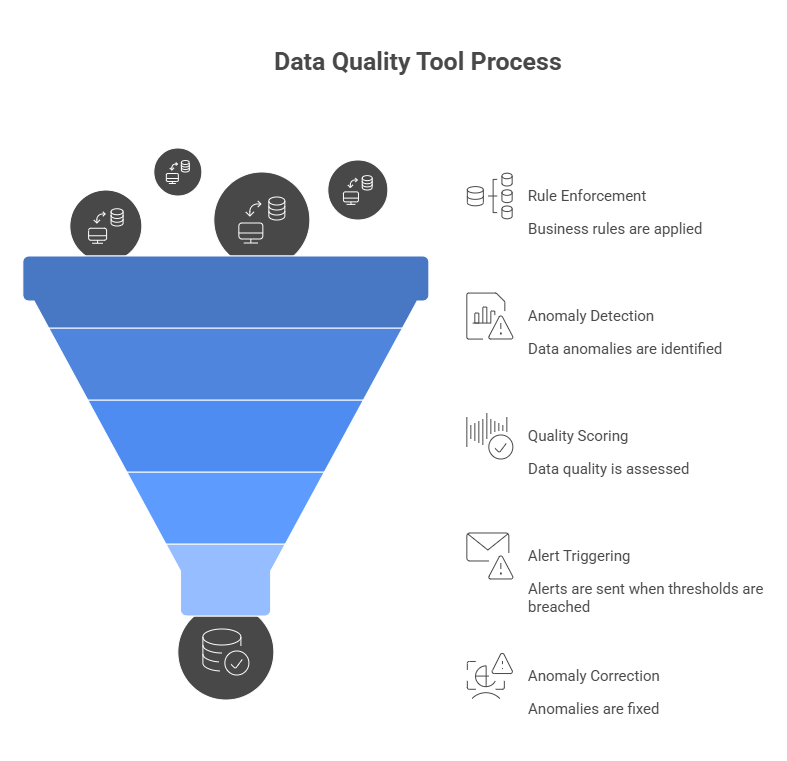
The fundamental difference between a simple data cleansing script and a Data Quality tool lies in its capacity for industrialization. A script fixes a known anomaly. A tool installs a permanent system capable of preventing, detecting, tracing, and correcting anomalies over time.A Data Quality tool is a sophisticated software platform designed to ensure the integrity of an organization's data by detecting, correcting, and preventing anomalies. Its operation spans the entire data lifecycle, from initial ingestion to final consumption, by automatically enforcing established business rules and generating clear, actionable quality metrics.
In complex enterprise ecosystems—encompassing systems like ERP, CRM, MDM, data lakes, and various analytics tools—the frequent movement of data introduces significant risks, such as inconsistencies, duplications, or data loss. The Data Quality tool functions as a crucial, cross-functional layer of reliability. It systematically maps data sources, formalizes quality standards, assigns measurable scores, and triggers automated alerts when predefined quality thresholds are violated.
The key distinction separating a Data Quality tool from a simple data cleansing script lies in its capacity for industrial-scale deployment. While a script provides a one-time fix for a known issue, a Data Quality tool implements a permanent, systemic infrastructure capable of long-term prevention, continuous detection, detailed traceability, and systematic correction of anomalies.
The 7 Dimensions of Data Quality
Before selecting a tool, it is essential to understand what data quality actually means in practice. The DAMA International framework identifies seven core dimensions. For a deep-dive into each dimension with concrete examples, read our full guide: What Is Data Quality?
|
Dimension |
Definition |
Control example |
|
Accuracy |
Data accurately reflects reality |
Customer address = real address |
|
Completeness |
No mandatory fields missing |
All contacts have a valid email |
|
Consistency |
Identical data between systems |
Sales in CRM = financial reporting |
|
Uniqueness |
No duplicate records |
Only one profile per individual |
|
Validity |
Compliance with format and rules |
Zip code FR = 5 digits |
|
Freshness |
Updates within an acceptable timeframe |
Stocks updated in real time |
|
Plausibility |
Realistic in context |
Order 10,000 units = alert |
Most organizations face issues across three to five of these dimensions on a daily basis. A Data Quality tool must address all of them to deliver complete data reliability.
Why Data Quality Fails Without a Dedicated Tool
Many organizations believe they are doing Data Quality because they use SQL, Python, or built-in ETL controls. These approaches are technically valid, but they hit their limits as volume and complexity grow.
A concrete example. A global retail group consolidates customer data from multiple countries. The data team builds scripts to detect duplicates. Results are solid in the short term. Six months later, new duplicates emerge, generated by inconsistent data entry or new source systems. The problem is not the script — it is the absence of a system.
According to IBM Institute for Business Value (2025), 43% of Chief Operating Officers identify data quality as their top priority. Yet Gartner estimates that 60% of AI projects will be abandoned due to insufficient data quality. The gap between awareness of the problem and its structural resolution remains significant.
What Real-World Problems Does a Data Quality Tool Solve?
A Data Quality tool addresses operational problems with directly measurable business impact.
Customer duplicates. They distort commercial KPIs and generate billing errors. Deduplication typically reduces duplicate records by 30 to 50% post-deployment.
Inconsistent product master data. The tool standardizes formats and normalizes reference data across subsidiaries to eliminate reporting discrepancies.
Incomplete data for AI. A predictive model trained on biased data reproduces those biases at scale. The tool ensures training datasets are reliable.
Regulatory non-compliance. GDPR, Basel III, and Solvency II all require full traceability. Without an auditable history, the risk of sanctions is high.
Cross-system inconsistencies. In the public sector, deduplication prevents attribution errors. In banking, customer data consistency is a core compliance requirement.
Data Quality Tool vs. ETL vs. Data Catalog vs. Data Observability
|
Criterion |
Data Quality Tool |
ETL / ELT |
Data Catalog |
Data Observability |
|---|---|---|---|---|
|
Primary function |
Measure, fix, monitor |
Extract, transform, load |
Document, make discoverable |
Monitor pipelines |
|
Acts on data content |
Yes |
Partially |
No |
No |
|
Correction traceability |
Yes (full audit trail) |
Limited |
No |
No |
|
Target users |
DQ Manager, business, Steward |
Data Engineer |
Analyst, Steward |
Engineer, DataOps |
|
AI-ready data prep |
Yes |
No |
No |
No |
An ETL moves and transforms data. A Data Catalog documents datasets. A Data Observability tool monitors pipeline health. A Data Quality tool, by contrast, operates on the intrinsic reliability of the data itself. Where the ETL executes a flow, the Data Quality tool secures it.
The key distinction: Observability signals problems; Data Quality solves them.
This fragmentation is pushing more and more organizations to look for platforms that consolidate multiple capabilities on a single foundation. That is the approach taken by Tale of Data, whose platform combines Data Quality, Data Catalog, ETL, and DataViz to cover the entire data lifecycle — from ingestion to publication — without multiplying tools or interfaces.Key capabilities of a modern Data Quality tool
|
Capability |
Description |
|---|---|
|
Data Profiling & Auditing |
Automated analysis of datasets to identify anomalies, missing values, and abnormal distributions. |
|
Fuzzy Deduplication |
Comparison using phonetic variants and contextual similarities with configurable thresholds. |
|
Standardization |
Alignment of formats (dates, addresses, product codes) to a common reference. |
|
Centralized Business Rules |
Controls defined, versioned, and shared across IT and business teams. |
|
Quality Scoring |
KPIs by dataset, by dimension, and by business domain. |
|
Full Traceability |
Every transformation logged and auditable. Essential in regulated environments. |
|
Augmented AI |
Pattern detection, remediation suggestions, automation. Key Gartner MQ 2026 criterion. |
|
IT-Business Collaboration |
No-Code interface enabling business team participation without IT dependency. |
What is the ROI of a Data Quality tool?
The ROI of a Data Quality tool operates on multiple levels: operational, financial, and strategic.
Reduced operational costs. Automating controls dramatically cuts manual work. Platforms like Tale of Data allow teams to configure and deploy data treatments in days, where scripted development used to take weeks.
Reduced financial losses. Gartner estimates $15M per year on average. MIT Sloan estimates 15–25% of revenue. Fixing data quality generates measurable returns within the first few months.
Faster AI project delivery. Gartner projects that 70% of organizations will adopt modern Data Quality solutions by 2027 to support their AI initiatives.
Confidence in business intelligence. Reliable data strengthens the credibility of dashboards and forecasts. Leadership teams make faster, better-informed decisions.
📊 Estimate the financial impact of your data quality in minutes — ROI Calculator
Why Data Quality Tools Have Become Critical for AI — and Especially Agentic AI
The rise of artificial intelligence has fundamentally changed the perception of data quality. A model learns from the data it is fed. If that data is biased, incomplete, or duplicated, the model will replicate those flaws at scale.
But it is with agentic AI that the stakes reach a new level of criticality.
Imagine an AI agent tasked with automatically qualifying your inbound leads. It queries your CRM, evaluates each prospect's score, and decides whether or not to send a commercial offer. If your CRM contains 23% duplicates, outdated addresses, and fields left blank after a failed migration, the agent does not crash — it makes confident decisions based on false data. It sends offers to the wrong people, ignores your best prospects, and generates real costs, all without ever signaling an error.
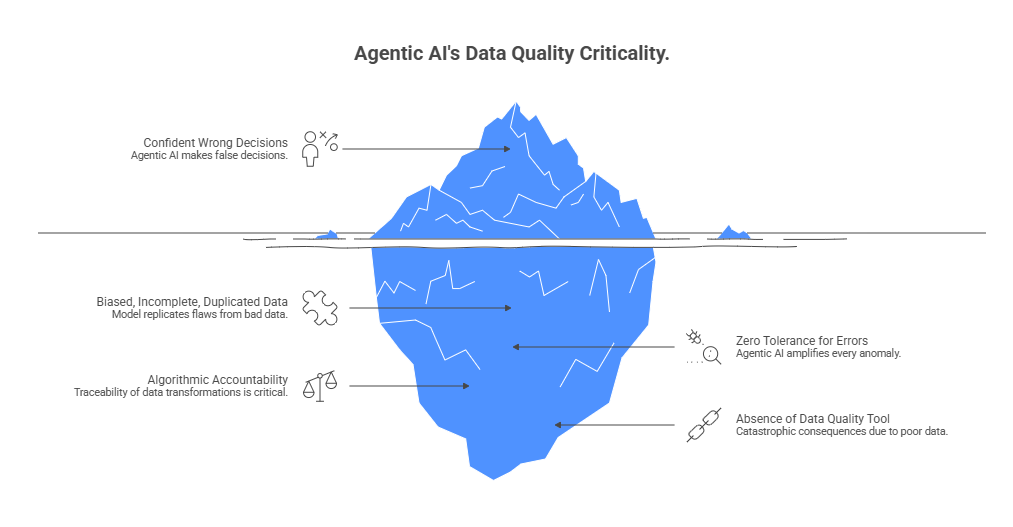
This is precisely where the absence of a Data Quality tool becomes catastrophic. Agentic AI has zero tolerance for errors — it amplifies every anomaly at the scale of automation. A misconfigured script produces a visible error. An AI agent running on dirty data produces thousands of invisible wrong decisions.
In the context of growing algorithmic accountability (EU AI Act), the traceability of data transformations is also becoming strategically critical: organizations must be able to prove that their training and inference data was reliable.
Tale of Data addresses this dimension by combining AI with human governance. The platform detects anomalies, suggests remediations, and automates rule creation — while allowing business teams to validate through a No-Code interface. Learn more: Making your data AI-ready
What a Data Quality Tool Must Guarantee to Be Enterprise-Ready
Universal connectivity. Relational databases, files, APIs, data lakes, cloud, and on-premises.
Hybrid deployment. Adapts to mixed environments without imposing a single architecture model.
Continuous automation. Real-time stream monitoring, automated alerts, and self-healing remediations.
IT-business collaboration. Business teams create rules and review KPIs independently of IT.
Enterprise scalability. Handles hundreds of millions of records without performance degradation.
How to Choose a Data Quality Tool: Key Selection Criteria
|
Criterion |
Key Questions |
|---|---|
|
Functional Coverage |
Does it cover all 7 dimensions? Profiling, deduplication, standardization, scoring, monitoring? |
|
Business Accessibility |
No-Code interface for Data Stewards and business teams? A critical adoption factor. |
|
Time to Value |
Tale of Data is operational within days to weeks. Legacy solutions can take 6 to 12 months. |
|
Traceability & Compliance |
Full audit trail? GDPR audit reports? Non-negotiable in regulated environments. |
|
Ecosystem Integration |
Native connectors for ERP, CRM, data lake, BI tools? Standard APIs? |
|
AI Capabilities |
Rule suggestions, pattern detection, automation? A top-tier 2026 criterion (Gartner). |
Customer testimonial - TotalEnergies
"Our challenge was to have a tool designed to detect and rectify data quality issues across our various heterogeneous data sources. It was essential for us to trust the data in our projects — especially digital projects (reporting, AI,...). Tale of Data gives our business users the autonomy and simplicity to define quality controls that require a deep understanding of their data."
- Benoit Soleilhavoup, Data Engineer, One Tech / Data Office / Data Quality & Modeling - TotalEnergies
TotalEnergies uses Tale of Data to ensure data reliability across dozens of business units worldwide: drilling reporting, industrial sensor monitoring, CRM data, HR management. A large-scale deployment made possible through No-Code and embedded AI.
Conclusion - From Data Quality to a unified platform: the Tale of Data approach
A Data Quality tool is not a simple technical fix. It is a trust infrastructure upon which governance, compliance, and artificial intelligence projects are built.
But tool fragmentation remains one of the biggest obstacles to data value creation. When an organization uses one tool for quality, another for cataloging, a third for integration, and a fourth for visualization, every additional interface adds complexity, inconsistency risk, and delays.
This is where Tale of Data is fundamentally different from competing solutions. Where these tools stack specialized modules — often the result of acquisitions — Tale of Data was designed from the ground up as a natively integrated, unified platform. By combining Data Quality, Data Catalog, ETL, and DataViz on a single AI-powered, No-Code foundation, the platform enables data, IT, and business teams to cover the entire data lifecycle — from ingestion to AI-ready outputs or certified dashboards — without multiplying interfaces, managing inter-module dependencies, or facing lengthy integration timelines.
Trusted by organizations including TotalEnergies, Manutan, BNP Paribas, France Travail, and the French Ministry of the Interior, the platform deploys in cloud, on-premises, or hybrid mode, with native integration into existing data architectures (SQL Server, Oracle, Snowflake, Salesforce, Azure, AWS, Databricks, and 30+ connectors).
In an environment where AI investment is set to surpass $2 trillion globally in 2026 (Gartner), the question is no longer whether data errors exist in your systems. They always do. The question is whether your organization has an industrial-grade system to detect, fix, and prevent their recurrence — on a single platform, without writing a single line of code.
✅ Test Tale of Data free for 30 days: start the free trial
📊 Measure the financial impact: ROI calculator
⚡ Instantly diagnose your data: launch a Flash Audit

Digital transformation of local authorities: data quality a prerequisite for success

Data Cleansing Services vs. Software: What to Choos