

Financial Data Quality Management: Framework, Risks and Best Practices
Finance teams do not have a reporting problem first. They have a trust problem in the data feeding their reports.
Most financial reporting issues do not start in dashboards, board packs or audit files. They start earlier, in duplicated supplier records, inconsistent account mappings, missing tax IDs, manual spreadsheet corrections, poorly documented transformations and data flows nobody can fully trace anymore.
By the time the numbers reach finance, the visible issue is rarely the root cause. A figure does not reconcile. A dashboard is challenged. An auditor asks for evidence. A closing process depends on manual checks. A business unit questions the numbers used to evaluate performance.
That is the real purpose of financial data quality management: preventing finance teams from spending every reporting cycle rechecking numbers they should already be able to trust.
Finance teams do not need more dashboards if the underlying data remains unreliable. They need numbers that are accurate, complete, consistent, traceable and defensible. Without that foundation, business intelligence becomes a source of debate instead of a source of decision-making.
What is financial data quality management?
Financial data quality management is the set of rules, controls, processes and responsibilities used to ensure that financial data remains accurate, complete, consistent, unique and traceable from source systems to final business use.
It applies to every dataset that influences financial decisions: transactions, invoices, supplier records, customer accounts, cost centers, chart of accounts mappings, tax identifiers, payment data, intercompany flows, regulatory figures and BI indicators.
In practical terms, financial data quality management answers five questions:
-
Can the data be trusted?
-
Is any critical information missing?
-
Does the same metric mean the same thing across systems and entities?
-
Can duplicates be detected and resolved?
-
Can every reported figure be traced back to its source?
This is why data quality in finance is not only a technical issue. It sits at the intersection of finance, data governance, audit, compliance, reporting and business intelligence.
Why financial data quality matters
Financial data is not passive information. It triggers decisions.
A forecast influences hiring, investment and budget allocation. A supplier record affects payments and fraud controls. A credit score can change borrowing conditions. A regulatory report can expose an organization to penalties. A BI dashboard can redirect executive attention toward the wrong priority.
Once these decisions are made, correcting the data afterward does not fully undo the impact.
The Citibank case shows how seriously regulators now treat data governance and internal controls. In 2020, the OCC assessed a $400 million civil money penalty against Citibank for deficiencies related to enterprise-wide risk management, compliance risk management, data governance and internal controls. In 2024, the OCC again pointed to insufficient processes to monitor the impact of data quality concerns on regulatory reporting.
The lesson is not limited to banking. Any organization that relies on financial reporting, audit evidence, compliance submissions or investor communication faces the same underlying issue: if financial data cannot be governed, traced and explained, the reporting built on top of it remains fragile.
The Equifax credit score error illustrates the same principle from another angle. Incorrect credit scores were sent to lenders for millions of consumers, potentially affecting loan approvals and borrowing conditions. A data quality issue became a real financial consequence.
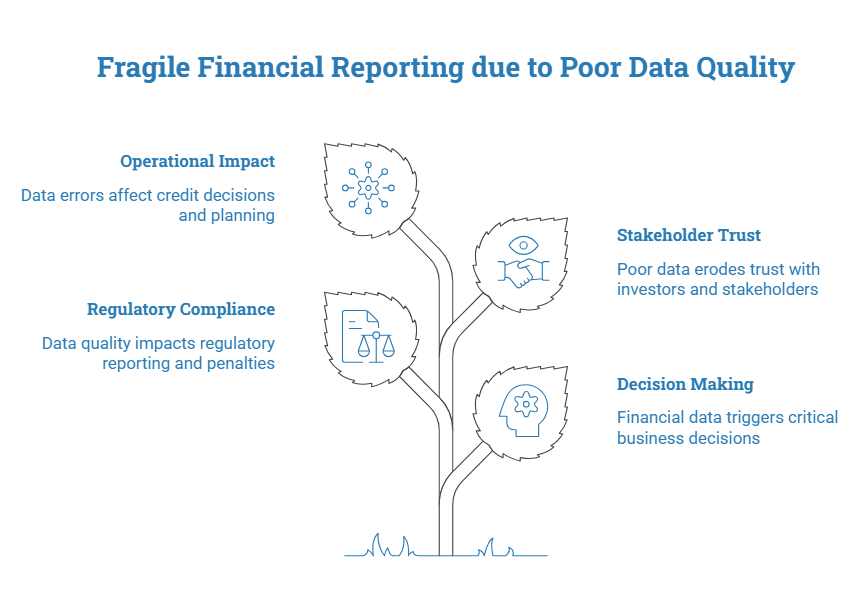
Poor financial data does not stay inside systems. It moves into reporting, BI, audit, compliance, credit decisions, operational planning and stakeholder trust.
Financial data quality management vs financial data governance
Financial data governance defines who owns financial data, which standards apply, who can modify data and how accountability is organized.
Financial data quality management is the operational layer that makes those rules real. It detects errors, applies controls, corrects anomalies, documents transformations and monitors data quality over time.
In simple terms:
Financial data governance defines the rules.
Financial data quality management applies and monitors those rules.
A finance team may have a governance policy requiring every supplier to have a valid tax identifier. But without automated checks, duplicate detection, exception handling and monitoring, that policy remains theoretical.
That is why financial data governance and financial data quality management must work together. Governance creates accountability. Data quality management creates reliability.
The five dimensions of financial data quality
Most financial data quality frameworks are built around five dimensions: accuracy, completeness, consistency, uniqueness and traceability.
1. Accuracy
Accuracy means the data reflects the underlying business reality. Invoice amounts, supplier details, payment statuses, account codes and tax identifiers must be correct.
An inaccurate payment status can distort cash visibility. An incorrect account code can affect management reporting. A wrong supplier ID can create payment or reconciliation issues.
2. Completeness
Completeness means critical information is present. Missing cost centers, entity codes, tax IDs, dates or transaction details can make financial reporting incomplete or misleading.
A transaction without a business unit may still be processed, but it becomes difficult to allocate, analyze or explain later.
3. Consistency
Consistency means the same concept is represented in the same way across systems, entities and reporting periods.
If one subsidiary classifies a cost as operational expenditure and another classifies the same type of cost differently, consolidated reporting becomes unreliable. The same applies to revenue categories, supplier types, product hierarchies and cost center structures.
4. Uniqueness
Uniqueness means each business object exists once.
Duplicate suppliers, customers, products, accounts or legal entities create reporting distortions, reconciliation issues and operational inefficiencies. Duplicate supplier data can also weaken fraud controls and spend analysis.
5. Traceability
Traceability means every figure can be followed back to its source, including the transformations, corrections and business rules applied along the way.
This is what makes financial data quality different from many other data quality topics. In finance, a number does not only need to be useful. It needs to be defensible.
If an auditor, CFO, regulator or board member asks where a figure comes from, the answer cannot depend on a spreadsheet owner, a forgotten script or someone’s memory of a manual correction.
Common financial data quality issues
Most organizations do not need to start with a complex data quality program. They need to identify the recurring issues that create rework, delays and doubt.
The most common financial data quality issues include:
Duplicate supplier records
The same vendor may exist several times under different names, addresses, tax IDs or local formats. This affects spend analysis, payment controls, fraud detection and supplier consolidation.
Inconsistent chart of accounts mappings
Different entities may classify similar expenses or revenue streams differently, making consolidated reporting unreliable.
Missing or invalid tax identifiers
Incorrect VAT numbers, SIRET numbers, company registration IDs or fiscal identifiers can create compliance risks and slow supplier validation.
Currency conversion inconsistencies
Exchange rates may be applied differently across entities, tools or reporting periods, especially when local teams maintain their own files.
Cost center and business unit mismatches
Transactions assigned to outdated or incorrect organizational structures can distort profitability, budget tracking and management reporting.
Manual spreadsheet adjustments
Corrections made during close may solve the immediate report but leave no reusable rule, no audit trail and no prevention mechanism.
Unclear data lineage between ERP, data warehouse and BI
A dashboard can show the right number and still create doubt if nobody can explain how that number moved from source system to final visualization.
These problems are rarely caused by incompetence. They are usually caused by fragmented systems, legacy processes, mergers, local practices, undocumented rules and years of manual workarounds.
Financial data quality checklist
A financial data quality checklist helps finance, data and IT teams identify the issues that should be fixed before they reach reporting, BI or audit processes.
Use these checks as a starting point:
-
Are supplier records duplicated across systems or entities?
-
Are tax identifiers complete, valid and correctly formatted?
-
Are chart of accounts mappings consistent across business units?
-
Are cost centers, entities and business units up to date?
-
Are intercompany flows reconciled before consolidation?
-
Are currency conversion rules consistent across systems and periods
-
Are manual corrections documented and reusable?
-
Are recurring errors transformed into automated data quality rules?
-
Can every critical BI metric be traced back to source data?
-
Are financial data quality controls monitored over time?
If the answer is unclear for several of these questions, the issue is not only data quality. It is reporting risk.
Where poor financial data quality creates the most damage
Financial data quality issues usually become visible in four areas.
1. Financial reporting and BI
BI only creates value when people trust the indicators.
When finance teams, business units and executives start questioning dashboard figures, the conversation shifts away from performance and toward reconciliation. Instead of asking “what should we do?”, teams ask “is this number correct?”
That is where BI loses its role as a decision-making layer and becomes another control layer. The dashboard may be technically modern, but if the data feeding it is duplicated, incomplete, inconsistent or poorly traced, users will not trust the output.
The issue is often misdiagnosed as a BI problem. In reality, the dashboard is only revealing a deeper data quality problem.
Want to go deeper into the link between data quality and BI performance?
Download Tale of Data’s white paper: How Data Quality Truly Drives Business Intelligence Performance. It explains why trusted data is the foundation of reliable dashboards, reporting and decision-making.
2. Month-end and year-end close
Closing cycles expose weak financial data quality very quickly.
Missing fields, invalid account mappings, inconsistent supplier records, unbalanced intercompany flows, manual adjustments and unexplained differences between systems all create friction.
Finance teams often manage to close on time, but the real question is how. If the process depends on manual corrections, undocumented spreadsheet logic and individual knowledge, the organization is carrying hidden risk.
The same issue returns every month because it was corrected in a report, not solved in the data flow.
3. Audit and compliance
Auditors do not only ask whether the number is right. They ask how it was produced.
They need to understand the source, the transformation logic, the controls applied, the corrections made and the people involved. Without clear lineage, audit preparation becomes a manual reconstruction exercise.
That creates delays, increases clarification requests and weakens confidence in the control environment. In regulated or highly audited environments, this can become a serious governance issue.
4. Upstream master data
Many financial reporting issues come from data that does not look “financial” at first.
Supplier master data, customer records, product hierarchies, entity structures, cost centers, contracts and tax identifiers all sit upstream of financial reporting. If they are duplicated, incomplete or inconsistent, they eventually affect spend analysis, cash management, invoice validation, fraud detection, consolidation and reporting accuracy.
A duplicate supplier record is not just a procurement issue. A wrong tax ID is not just an administrative issue. A broken cost center hierarchy is not just a data management issue. In the end, all of these issues can become finance issues.
How financial data quality improves financial reporting accuracy
Financial reporting accuracy depends on more than accounting expertise. It depends on the reliability of the data that enters reporting processes.
When financial data quality is weak, reporting teams spend more time reconciling, checking and adjusting figures. The report may eventually be delivered, but the process becomes slower, riskier and harder to audit.
Strong financial data quality improves reporting accuracy in four ways.
First, it reduces errors before they reach reports. Validation rules can detect missing fields, invalid formats, duplicate records or inconsistent mappings earlier in the process.
Second, it improves consistency across entities and periods. When account mappings, cost centers, currencies and business rules are standardized, consolidated reporting becomes more reliable.
Third, it strengthens traceability. Finance teams can explain how a figure was produced, which source it came from and which transformations were applied.
Fourth, it reduces dependency on manual corrections. Instead of fixing the same issues every month in spreadsheets, teams can turn recurring corrections into reusable controls.
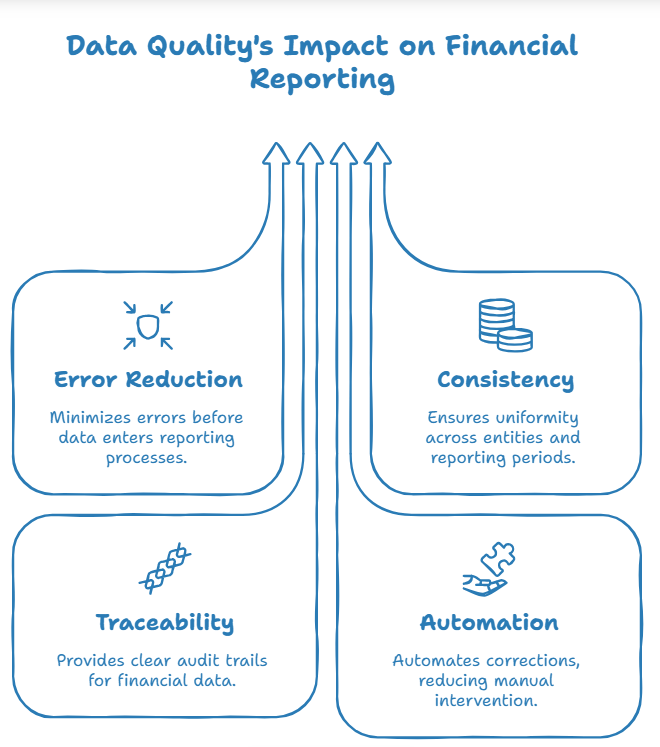
Financial reporting accuracy is therefore not only a reporting challenge. It is a data quality challenge.
Why spreadsheets and manual fixes do not scale
Spreadsheets are not the enemy. Finance teams use them because they are flexible, fast and familiar.
The problem starts when spreadsheets become the hidden control layer of financial reporting.
A typical pattern looks like this: a data issue appears during close, someone corrects it manually, the report is delivered, the deadline is met, and everyone moves on. But the correction is not turned into a reusable rule. It is not documented in a controlled workflow. It is not applied upstream.
So the same problem returns next month, sometimes in another file, another entity or another report.
This is how financial data quality debt accumulates.
Not through one dramatic failure, but through hundreds of small manual corrections that never reach the source of the problem. The organization appears to function, but the cost is absorbed by finance teams through repeated reconciliation, late checks, audit preparation and loss of confidence in reporting.
At some point, this becomes a scaling problem. More entities, more systems, more reporting requirements and more data volumes make manual correction harder to sustain.
Financial data quality metrics to track
Before improving financial data quality, teams need to make the problem visible. The goal is not to create another reporting burden. It is to identify where risk and rework actually sit.
Useful financial data quality metrics include:
Source error rate
What percentage of supplier records, invoices, account entries or transactions fail basic validation rules when first captured?
Duplicate rate
How many suppliers, customers, accounts or products appear more than once across systems?
Manual correction volume
How many adjustments are made during each reporting cycle, and which ones repeat?
Time spent reconciling
How much of the close process is spent investigating inconsistencies instead of analyzing results?
Audit query rate
How many clarification requests are raised by internal or external auditors, and how long does each one take to resolve?
Lineage coverage
What percentage of critical financial indicators can be traced from final report back to source data and transformation logic?
The objective is not to reach perfection on day one. It is to prioritize. Once teams know which data issues create the most rework, delay or risk, they can focus their efforts where business impact is highest.
Framework and Best Practices to Improve Financial Data Quality
Building a strong financial data quality management framework does not need to start with a large-scale transformation project. The most effective approach is often progressive: start with a critical reporting process, identify recurring issues, define reusable rules, and then industrialize the controls.
Map Critical Financial Data Flows
The first step is to identify the datasets that feed reporting, consolidation, audit, or BI. Teams need to understand where the data comes from, how it moves, who modifies it, which transformations are applied, and which reports depend on it.
This mapping gives finance, data, and IT teams a shared view of the real data journey. It also helps focus efforts on the most sensitive flows instead of launching a project that is too broad from the start.
Profile Data Before Correcting It
Once the flows have been identified, teams need to analyze the actual state of the data: missing fields, duplicates, invalid formats, unusual values, broken relationships, or inconsistent categories.
This step replaces assumptions with measurable facts. It also prevents teams from correcting data blindly, without knowing which issues actually create risk, delays, or rework in financial processes.
Define Business Rules with Finance Teams
Financial data quality cannot be treated only as a technical issue. Finance teams know what is acceptable, suspicious, or impossible in their context.
Rules should therefore reflect operational reality: mandatory fields, valid formats, chart of accounts mapping logic, supplier validation requirements, control thresholds, reconciliation criteria, and exception handling.
An effective rule must be understandable by business users. If only IT can understand it, it will be difficult to validate, challenge, and maintain over time.
Automate Controls and Document Corrections
To scale, validated rules must become automated and reusable. Recurring issues should not be corrected manually every month in spreadsheets.
Once an anomaly is detected, the correction process should be documented. Once a control is in place, it should run automatically and keep a trace of the corrections applied. This reduces dependency on manual checks and makes financial data easier to audit.
Monitor Data Quality Over Time
Financial data quality is not a one-time cleanup. New suppliers, new entities, new products, new systems, and new reporting requirements constantly introduce new risks.
Continuous monitoring helps detect drift before it reaches dashboards, audit files, or closing reports. This is what turns financial data quality into a sustainable process rather than a series of one-off corrections.
Prioritize the Most Critical Data
Not all data has the same impact on reporting, audit, or decision-making. Teams should start with the most sensitive datasets: suppliers, customers, accounts, cost centers, entities, transactions, or key financial indicators.
This prioritization helps deliver visible results quickly while avoiding scattered efforts. The goal is not to fix everything at once, but to address first the data that creates the most risk, rework, or loss of trust.
Financial data quality management software: what to look for
Financial data quality management software should do more than detect errors. It should help teams understand, correct, document and prevent them.
Key capabilities include:
- Data profiling to detect missing values, anomalies, duplicates and unusual patterns.
- Business rule management to define and apply financial data quality controls without relying only on code.
- Deduplication and matching to identify duplicate suppliers, customers, products or accounts even when records are not exactly identical.
- Data lineage to trace data from source systems to final reports and dashboards.
- No-code remediation to let finance and data teams correct recurring issues without waiting for every change to become an IT project.
- Monitoring and alerts to detect new data quality issues before they affect reporting.
- Integration with existing systems such as ERPs, databases, files, data warehouses and BI tools.
The goal is not to replace finance systems, ERPs or dashboards. The goal is to create a trusted data quality layer upstream of them.
Where Tale of Data fits
Tale of Data helps finance, data and IT teams detect, correct, trace and monitor data quality issues across existing systems without relying on manual scripts or disconnected spreadsheets.
The platform acts as a no-code, AI-powered data quality layer upstream of reporting, BI and operational systems. It does not replace ERPs, finance tools or dashboards. It helps ensure that the data feeding them is cleaner, more consistent and easier to explain.
For financial data quality management, Tale of Data can help teams:
- audit financial datasets before they feed reporting or BI;
- detect duplicates in supplier, customer or reference data;
- validate formats, mandatory fields and business rules;
- reconcile data across ERPs, files, databases and data warehouses;
- document corrections and make them reusable;
- trace how data moves from source to final output;
- monitor critical datasets over time;
- give business users more autonomy without removing IT governance.
The value is not only technical. It is organizational. Finance, data and IT teams can work on the same data quality rules, with the same evidence, in a process that is traceable and repeatable.
That is the difference between fixing a report and improving the data foundation behind every future report.
Getting started with financial data quality management
The fastest way to improve financial data quality is to stop guessing where the risk is.
Which datasets create the most manual rework?
Which supplier or customer records are duplicated?
Which financial indicators cannot be clearly traced to source?
Which corrections return every month?
Which dashboards are trusted, and which ones are challenged?
Before launching another BI, reporting or finance transformation initiative, first identify whether the data behind your reports can actually be trusted.
Request a free Flash Audit of your financial data quality to identify where your reporting risk actually sits and which data issues should be fixed first.
If your priority is BI and reporting performance, you can also start by downloading our white paper: How Data Quality Truly Drives Business Intelligence Performance.

For teams that want to test the platform directly, Tale of Data also offers a Free Trial to run data quality checks on real datasets.

Pharmaceutical Data Management: A Life Sciences Guide

Data Quality: The Foundation of Business Intelligence Performance