

Why agentic AI is failing in production (and why nobody is talking about it)
Agentic AI is now entering production. Organizations are deploying systems capable of orchestrating processes, triggering actions and making decisions in complex environments, with minimal human mediation. In the pilot phase, results seem to be under control. In production, a more subtle misalignment emerges: systems don't collapse, they just become progressively more difficult to explain.
Decisions remain algorithmically coherent, but gradually drift away from business intent. The loss of confidence does not come from a major incident, but from an accumulation of weak signals. This shift generally occurs when :
- implicit business rules become executable without having been formalized ;
- discrepancies between data sources are no longer compensated for by human arbitration;
- exceptions that have historically been managed informally are industrialized;
- traceability can no longer clearly explain an automated decision.
The temptation is to blame models or autonomy. In reality, production doesn't "break" agentic AI: it makes operational data ambiguities that the organization never needed to clarify as long as the human remained at the center of decision-making.
Why Production Reveals What Organizations Never Formalized
Production environments don't introduce new problems. They make visible those that organizations have learned to manage without ever formalizing them. For years, decision-making systems have been based on an implicit foundation: business rules known but rarely written down, corrections applied manually, undocumented human judgment. As long as people remained at the heart of decision-making, this informality posed no major problems. In some contexts, it even constituted a form of organizational efficiency.
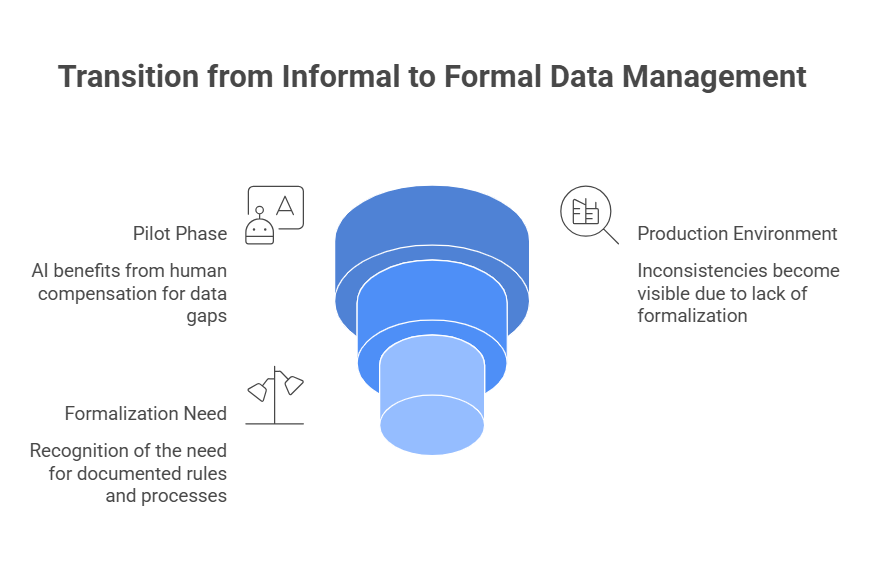
In the pilot phase, AI benefits precisely from this buffer. Perimeters are reduced, data selected and use cases clearly understood. When inconsistencies arise, they are absorbed by human intervention. A business expert adjusts his interpretation, an analyst applies a correction based on experience rather than on a written rule, an exception is dealt with out of habit, without ever being documented. The system works not because the data is perfectly defined, but because the human compensates for what is not.
This apparent stability can be deceptive: until ambiguities are explicitly identified, they remain invisible. Rapid assessment tools, such as a Flash Audit, help surface these areas of uncertainty before they become executable on a large scale.
When Production Removes Human Arbitration
The transition to production radically alters this balance. AI systems are exposed to large-scale operational flows, stemming from systems built at different times, according to different constraints, and often reflecting divergent interpretations of core business concepts of central business notions. Rules, hitherto dispersed between teams, tools and uses, now find themselves executed simultaneously. Corrections historically applied manually continue to exist, but with no clearly identified person in charge, no traceability and no explicit validation.
At this stage, what was manageable by human interpretation becomes fragile when executed automatically. Production doesn't create ambiguity; it makes it operative. It's this mechanism that explains why so many AI projects appear stable in the pilot phase, then gradually deteriorate once confronted with operational reality.
Gartner observes that over 60% of AI project failures in production are attributable to problems of data quality, context or governance, far more than to limitations of the models themselves (Gartner, Why AI Projects Fail, 2023).
Agentic architectures are not the cause of this fragility.
They simply put an end to the illusion that it was under control.
Is Autonomy Really the Problem?
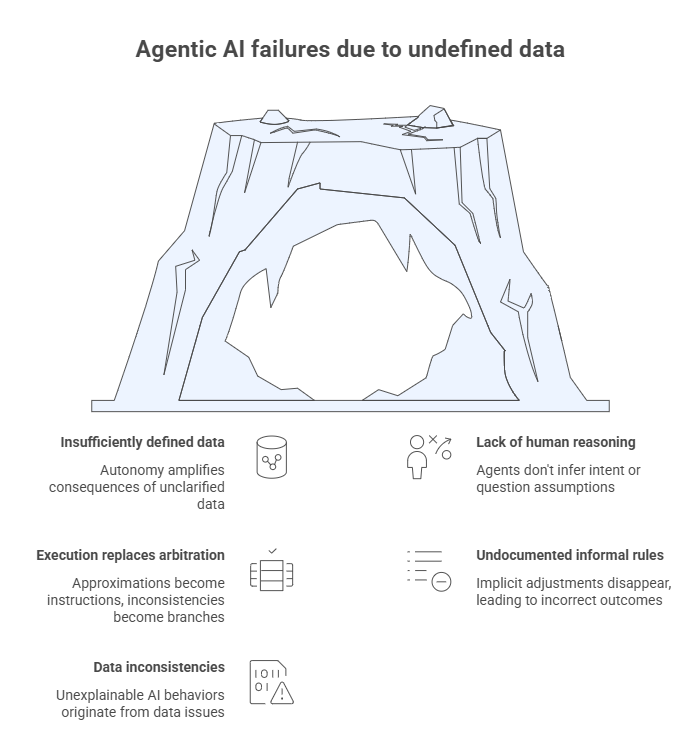
Autonomy is frequently referred to as the main risk factor in agentic AI. In practice, it is neither intrinsically beneficial nor intrinsically dangerous. What turns autonomy into a systemic failure factor is its application to insufficiently defined data environments. Autonomy doesn't introduce error; it amplifies the consequences of what has never been clarified.
An agent doesn't reason like a human. It does not infer intent, question implicit assumptions or recognize historical compromises built up over time. It makes decisions based on the data, rules and contextual signals available to it, whether explicit, implicit or partially contradictory. Where co-pilots are still embedded in human reasoning , agents operate without mediation.
When execution replaces arbitration, the shift is mechanical:
- Any approximation becomes an executable instruction
- Any inconsistency becomes a decision branch
- Any obsolete data produces a technically valid but operationally erroneous decision.
The result is not chaos, but coherence built on fragile premises.
This mechanism is clearly visible in concrete use cases. Take the case of an agent responsible for determining customer eligibility in a large financial services organization. In the pilot phase, discrepancies between the CRM, billing and compliance repositories were well known to the teams and corrected manually using informal rules, aligned with business reality but rarely documented. Once the agent was deployed in production, these implicit adjustments disappeared. The agent did not fail. It executed, in a perfectly coherent way, an organizational reality that had never been explicitly defined.
Empirical data confirms this phenomenon. According to Accenture, over 80% of AI behaviors deemed unexplained originate in data inconsistencies, contextual gaps or governance blind spots (Accenture, Responsible AI Report, 2024). In these situations, the agent doesn't make mistakes; it faithfully applies a pre-existing ambiguity on an industrial scale.
Why Data Quality Becomes a Production Asset
As soon as decisions are delegated to autonomous systems, data quality ceases to be a mere technical issue. It becomes a condition of execution. Without reliable, traceable and governed data, autonomy is no longer sustainable, either operationally or organizationally.
This reality also has a direct economic impact. Correcting a data quality problem after it has been put into production costs on average five to ten times more than when it is identified and dealt with upstream. As AI becomes decision-executing, this differential ceases to be marginal; it becomes structural.
Organizations that succeed in deploying agentic AI in a sustainable way don't rely on more sophisticated models. They have data foundations capable of supporting autonomous execution over time:
- Explicit, documented and governed business rules
- End-to-end traceable data transformations
- Quality controls integrated into operations
- Ability to explain and justify every automated decision
This is precisely the logic behind approachesaimed at making data AI-ready before exposure to autonomous systems, rather than correcting a posteriori decisions that have already been executed. It's not a question of improving data in the abstract, but of building an explicit, traceable and governed foundation capable of supporting autonomy without drift.
👉 On this point, see also:
[Why data quality is essential for agentic AI]
Agentic AI doesn't require perfect data.
It requires understandable, explainable and justifiable data.
Conclusion — From Silent Failure to Sustainable Autonomy
The strategic question is no longer whether agentic AI will be adopted. That trajectory has already begun. The real question now is whether organizations can deploy these systems on a large scale without compromising trust, compliance and operational stability.
The most critical failures are not spectacular; they are silent. Systems work, decisions flow, but the gap between business intent and execution gradually widens.
Successful organizations reverse the classic sequence: they formalize before automating, govern before delegating, and consider data quality not as a corrective project, but as a prerequisite for any sustainable autonomy.
This shift - from model-centric optimization to data-centric preparation - is the real dividing line between experimental successes and sustainable agentic architectures in production.

Why Data Quality Is Essential for Agentic AI

Can Vibe Coding Handle Your Organization's Data?