

AI Readiness: how to build truly reliable data for robust AI projects
The reality on the ground: AI rarely fails because of the model, but almost always because of the data
Over the past two years, companies have been accelerating their investments in artificial intelligence. Enthusiasm is real, use cases are multiplying and architectures are evolving rapidly, particularly with generative models, AI agents and hybrid approaches blending BI and predictive intelligence. However, the adoption curve is nowhere near as linear as we might have imagined.
In successive reports published by MIT Sloan, Gartner and the Stanford AI Index, there is one constant: the performance gaps observed between training and production stem, in over 60% of cases, from the quality and structure of the underlying data.
Companies often realize this late in the game, when AI is confronted with the reality of data flows, the diversity of systems and the heterogeneity of business contexts.
Generative models amplify this phenomenon. Where a traditional model could absorb structural variations to a certain extent, a generative model depends on a rich, coherent, contextualized and stable context. A slightly ambiguous piece of data, an ill-defined field or a partially synchronized repository can produce a contrasting, sometimes even contradictory, output.
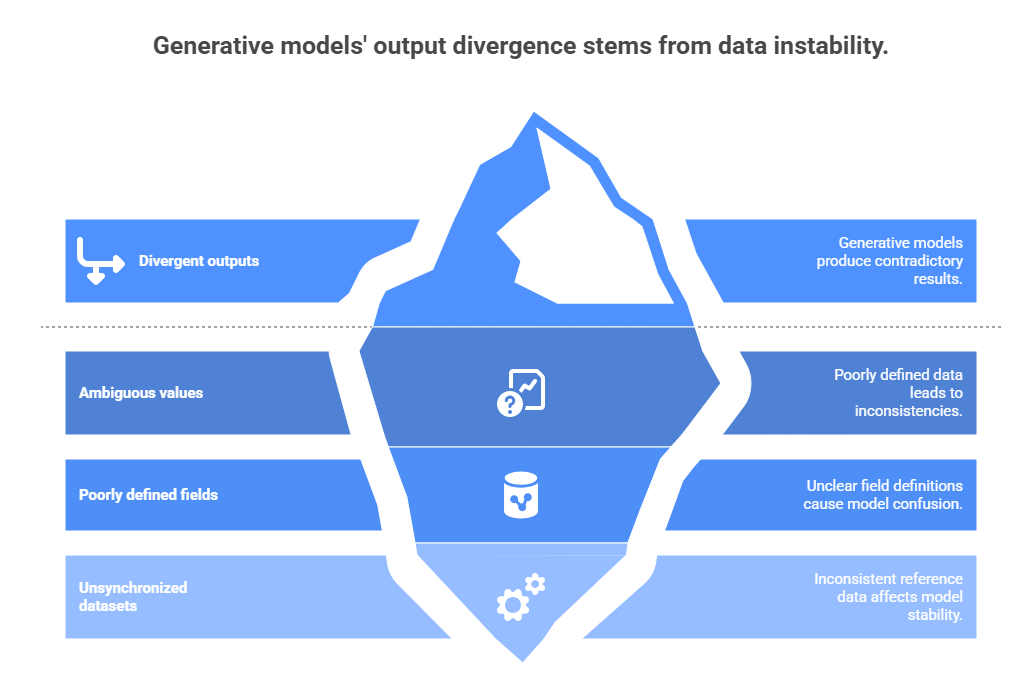
This situation is not the result of a weakness in the models. It illustrates the place that data now occupies: a structural variable, not a simple ingredient.
Several leading organizations have documented this point: 83% of AI hallucinations studied by Accenture stem from inconsistencies in the data, not in the model itself. And, according to Gartner, almost 70% of the drifts observed in production could be anticipated if data were systematically checked before use.
This convergence of observations explains why AI Readiness has become a priority issue not only for data and IT teams, but also for business, legal and risk departments.
Data is no longer a secondary element in AI: it is the condition of its existence.
1. The five core capabilities of AI Readiness: a framework drawn from leading standards organizations
The major international standards converge on a common foundation. Whether it's NIST's work on AI risk management, the structure of the DAMA-DMBOK or the quality assurance models defined by ISO, the capabilities required to support reliable AI are divided into five interconnected dimensions.
Intrinsic quality
Quality is above all a question of granularity: completeness, accuracy, cross-system consistency, absence of duplication and stability over time.
Data must be sufficiently homogeneous to avoid the propagation of errors, a point repeatedly emphasized in McKinsey Analytics studies.
Standardization and data models
Mature organizations define clear, stabilized business primitives, understandable by both data teams and models.
NIST points out that most AI discrepancies in production are not due to a lack of training, but to a gradual divergence between the formats actually used and those expected.
Governance and traceability
The regulatory framework is evolving rapidly. The AI Act requires the ability to trace every significant use and transformation of data.
Without lineage, it becomes impossible to justify model behavior or explain an automated decision.
Content observability
This is probably one of the areas that has progressed the most in the last two years.
We've been monitoring systems for a long time - latency, availability, pipelines - but much less so the content itself: statistical breaks, gradual shifts, sudden variations in distributions.
Ongoing remediation
Detection alone is not enough.
An AI environment requires the ability to immediately correct, replay, validate and document, in order to avoid silent drift.
This is precisely the aspect where organizations see the most value, as it not only improves the data, but also significantly reduces the operational maintenance effort.
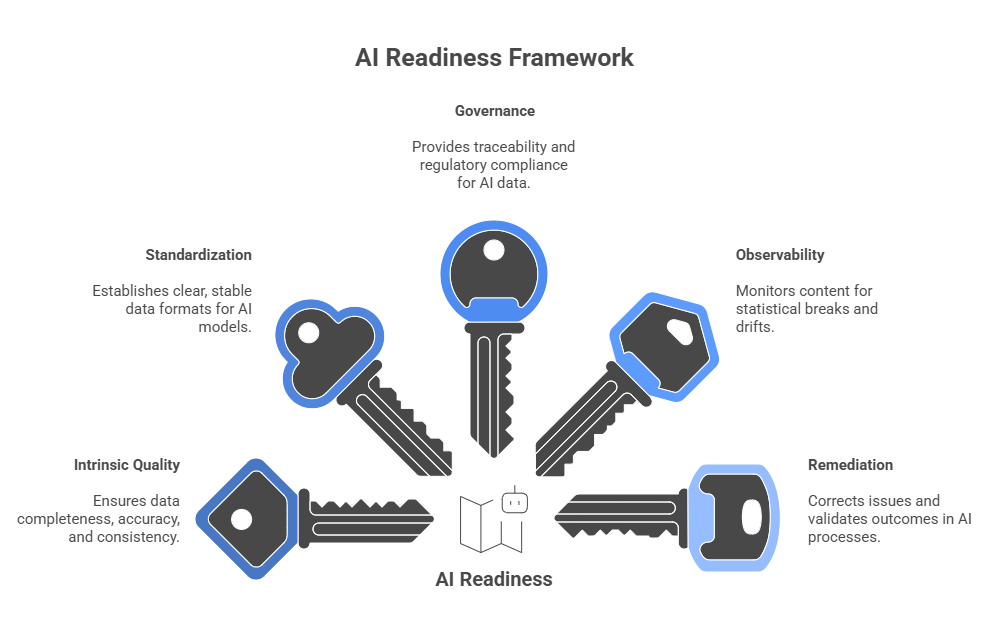
These capabilities form the backbone of AI Readiness: a coherent vision, supported by leading standards bodies, and now embraced by companies seeking to stabilize their AI environments.
2. From vision to operationalization: the AI Readiness method implemented in advanced organizations
Organizations that have mastered their AI projects owe this not to more sophisticated models, but to a much more methodical approach to the data preparation cycle. An approach that doesn't seek to multiply initiatives, but to industrialize the fundamental mechanisms that guarantee the quality and stability of data flows.
The first step is always diagnostic.
You can't improve what you don't measure, nor correct what you haven't yet observed. The most advanced companies carry out continuous audits, often automated, to identify inconsistencies, unexpected patterns, lexical drifts, temporal variations or areas where business rules diverge from one system to another.
In this context, a clear initial diagnosis remains the best way to obtain a realistic vision of the data. This is exactly what the Flash Tale of Data Audit offers, enabling you to measure the real state of your data in just a few minutes, and to gain 30 days' access to the platform to explore, correct, document and govern your data flows.
.png?width=350&height=371&name=unnamed%20(2).png)
The second step is to stabilize structures.
This involves standardizing attributes, unifying repositories, clarifying business definitions and reducing variability. Without this work, both generative and traditional models are confronted with contradictory or poorly contextualized data, which limits their ability to produce reliable results.
The third step is to consolidate governance.
Transformations must be explicit, rules visible, impacts measurable and traceable. Teams must be able to understand the complete data cycle, from its origin to the models that exploit it.
Finally, the last but most decisive step is automation.
In environments where data is constantly evolving, remediation automation, continuous monitoring and correction historization become essential to guarantee long-term stability.
These four steps do not form a theoretical method: they are derived from actual practices observed in companies that have successfully industrialized AI.
3. How Tale of Data makes AI Readiness operational: a platform designed as the last layer before AI
Companies with successful AI projects have understood one simple thing: the last link before the model is also the most decisive.
This is where data must not only be correct, but consistent, interpretable, and sufficiently contextualized to feed stable algorithmic reasoning.
Tale of Data has been designed specifically for this critical moment.
Its AI-native architecture is based on engines for automatic anomaly detection, semantic categorization, quality scoring and intelligent suggestion of remediation rules.
Each brick can be orchestrated without code, controlled via API, or triggered according to configurable business thresholds.
This modular design makes it easy to integrate the platform into complex environments, without reconfiguring existing pipelines.
Observe what other tools ignore
Where conventional systems are content to spot visible errors: duplicates, empty fields, incorrect formats, Tale of Data focuses on detecting weak signals.
It analyzes structural breaks, gradual shifts, divergences in usage between professions, and ambiguous contexts.
It is precisely these nuances that AI models misinterpret, often without anyone realizing it.
Thanks to observability focused on data content, not just on its technical circulation, the platform enables us to anticipate errors that emerge too late in other projects.
This level of control requires no line of code. It gives all profiles, technical and non-technical alike, an easy-to-read dashboard on the real health of the data.
Correct without breaking governance
Observation is not enough. Tale of Data also enables you to act quickly and cleanly.
Remediation is never a black box.
Each correction is based on explicit, validated and historicized business rules.
The AI engine does not replace the human: it suggests, documents and improves efficiency.
Teams retain total control over each transformation, while reducing manual effort.
It's this ability to correct without weakening traceability that makes the platform compatible with RGPD requirements, and anticipates the future AI Act.
Correcting becomes a business process in its own right, and no longer a technical operation outside the field.
Bringing IT, data and business closer together
In most organizations, the biggest obstacle to quality remains the separation of responsibilities: business people know the rules, but don't have the tools; data engineers have the tools, but not always the context.
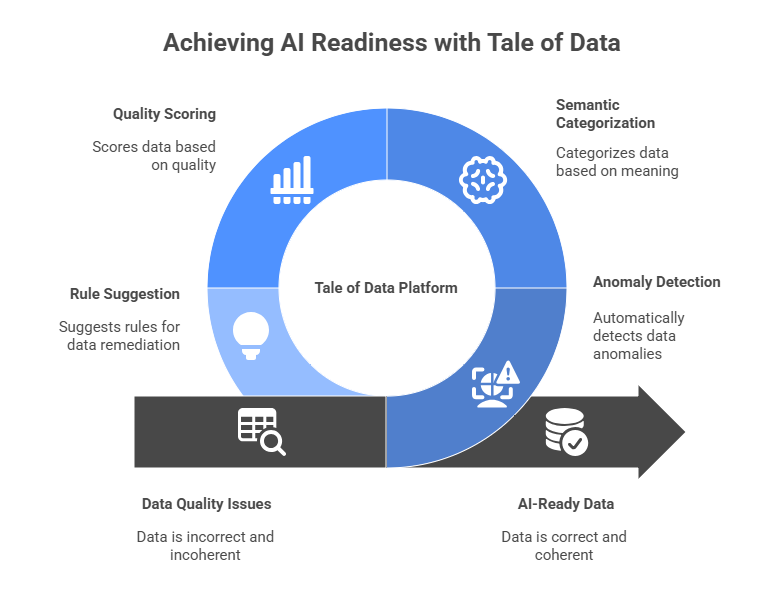
Tale of Data removes this barrier. The No-Code interface enables business experts to define quality rules themselves. Data teams automate without losing readability. IT departments supervise, govern and historize. Everyone can contribute at their own level, with no grey areas or loss of control.
But beyond this clear division of roles, the platform fosters a new dynamic: that of active, traceable collaboration, where each player can comment, test and iterate. Every rule becomes a shared object, every correction a documented action, every flow a point of dialogue between skills. Quality ceases to be an individual effort. It becomes a collective, fluid, governed and sustainable process.
This approach is detailed on the page dedicated to data reliability for AI :
Organizations wishing to assess their current level can start with a simple diagnostic via the Flash Audit, then go deeper with the 30-day platform access to measure the real impact of remediation and ongoing governance.
Conclusion: data reliability is no longer an option in a world where AI is becoming a decision-making tool
AI is no longer an experimental field.
It is influencing decisions, structuring processes, speeding up operations and, in some cases, engaging the legal liability of organizations.
Faced with this evolution, data quality is no longer a technical exercise: it's a measure of maturity.
Performance, compliance and explainability rest on a single foundation: the ability to prepare, stabilize and govern data before it is used by AI.
Tale of Data is designed to do just that: offer a platform capable of ensuring that the data used by models is reliable, controlled and aligned with European standards.
To find out more
👉 Explore our guide dedicated to reliable data for AI
👉 Test your level of data quality with the Flash Audit

Why Agentic AI Fails in Production — And What Data Governance Has to Do With It

AI Won't Fix Your Data Quality — Here's What Will