

Supplier Master Data Management: Why Vendor Records Don't Match and How to Fix Them
Supplier master data management is not a project you finish. It is a discipline you maintain. The moment a new supplier is onboarded through a purchase order, an invoice, or a spreadsheet upload, the conditions for duplication are already in place.
A vendor analytics study that examined supplier and employee master records across large organizations found 7,216 vendors with different names sharing the same address, and 4,745 vendors with different names sharing the same bank account. These overlaps do not automatically mean fraud. They often reflect data quality issues in the source systems. But they show how invisible the problem stays until someone goes looking for it.
This guide covers what supplier master data management actually involves, why vendor records drift apart even in well-run organizations, where it costs the most, what a complete approach looks like, and what to look for in supporting software — including the specific case of French SIRET and SIREN validation, where supplier data quality has a direct regulatory dimension.
What Is Supplier Master Data Management?
Supplier master data management, often shortened to supplier MDM, is the set of processes and controls that ensure each supplier exists once, consistently, across every system that depends on that record: ERP, procurement, finance, and reporting.
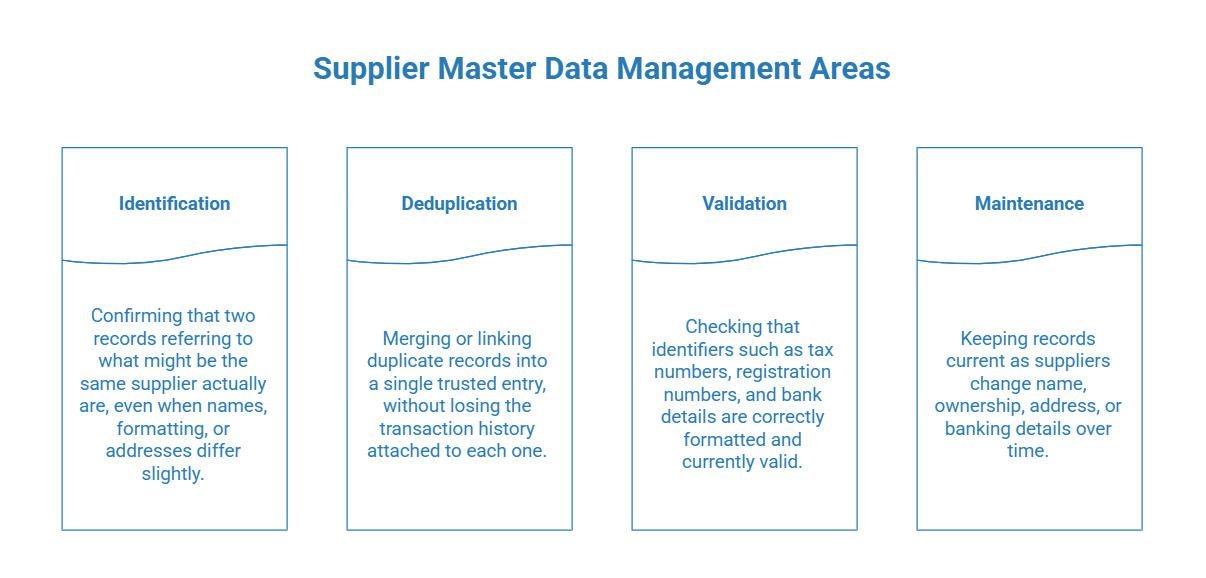
It typically covers four areas:
- Identification — confirming that two records referring to what might be the same supplier actually are, even when names, formatting, or addresses differ slightly.
- Deduplication — merging or linking duplicate records into a single trusted entry, without losing the transaction history attached to each one.
- Validation — checking that identifiers such as tax numbers, registration numbers, and bank details are correctly formatted and currently valid.
- Maintenance — keeping records current as suppliers change name, ownership, address, or banking details over time.
What makes supplier data harder to manage than most other master data is that it does not originate from one team. Procurement creates a record. Finance updates banking details. A regional office adds a local entity. Each interaction is legitimate on its own, but none of them is automatically reconciled with the others.
Why Supplier Data Quality Matters
Supplier records sit upstream of nearly everything procurement and finance do: payments, spend analysis, contract compliance, and supplier risk assessment. When the underlying identity of a supplier is unclear, every process built on top of it inherits that uncertainty.
The consequences tend to surface in four places:
- Payments can go to the wrong record, or duplicate payments can occur when the same supplier exists under two entries.
- Spend analysis fragments across multiple records for what is actually one entity, hiding consolidation opportunities and weakening negotiating leverage.
- Compliance exposure grows when tax identifiers or registration numbers are missing, outdated, or wrong, since audits routinely flag these as findings requiring remediation.
- Supplier risk assessment becomes harder, because outdated ownership or banking information obscures who the organization is actually dealing with.
None of this requires a dramatic failure to become expensive. It accumulates quietly, the same way the address and bank-account overlaps found in large vendor masters typically reflect years of uncoordinated data entry rather than a single event.
Supplier Master Data vs. General Master Data Management
Supplier MDM is often treated as a subset of master data management in general, alongside customer, product, and reference data. The overlap is real — the same matching and governance principles apply — but supplier data carries two traits that justify treating it as its own discipline.
First, supplier records are tied to legal and fiscal identity, not just business convenience. A duplicate customer record is an inconvenience; a duplicate supplier record with a mismatched tax ID is a compliance finding.
Second, supplier data is created by more functions with less coordination than most other master data. Procurement, finance, and regional teams all touch the same supplier independently, which is precisely the pattern that produces duplicates in the first place.
Supplier MDM vs. Supplier Data Cleansing
The two are often confused, but they solve different problems.
Supplier data cleansing fixes the vendor file once. Duplicates are merged, formats are corrected, and the file looks clean.
Supplier master data management creates the rules, controls, and ownership model that prevent the same duplicates from returning. It is the difference between a clean snapshot and a system that stays clean.
A cleansing project answers: “Is our vendor file clean today?”
Supplier MDM answers: “Will it still be clean in a year, and can we prove how each record got there?”
Most organizations have already run the first. Few have built the second.
Suggested internal link: link “data cleansing” to the future article “Data Cleansing Services vs Software” once published, and link “remediation” to the Data Remediation article.
Common Supplier Data Issues
A handful of recurring problems account for most of the cleanup work in practice:
- Duplicate vendor records — the same legal entity registered multiple times under slightly different names, abbreviations, or regional spellings.
- Invalid or missing tax identifiers — incorrect VAT numbers, SIRET or SIREN codes, or company registration numbers that block validation or payment processing.
- Outdated banking details — accounts that changed after an acquisition or restructuring but were never updated in the system of record.
- Incomplete parent-child hierarchies — subsidiaries treated as unrelated suppliers, masking concentration risk and consolidation opportunities.
- Stale ownership or status information — a supplier that has merged, been acquired, or ceased trading, with no flag anywhere in the system.
These issues rarely appear all at once. They accumulate over time, across systems, teams, countries, and manual updates. That is why supplier master data management needs to be treated as an ongoing control layer, not as a periodic cleanup exercise.
Validating French Suppliers: SIRET and SIREN
For organizations operating with French suppliers, identity validation has a specific regulatory anchor: every registered business holds a SIREN number, which identifies the legal entity, and one or more SIRET numbers, which identify each physical establishment.
These identifiers follow a defined format and checksum, which means they can be validated automatically rather than checked by hand.
This matters in practice because a malformed or outdated SIRET is one of the most common reasons a supplier record fails downstream validation — in invoicing, compliance checks, or cross-referencing against official business registries.
Automated SIRET and SIREN validation catches the issue at the point of entry, rather than after an invoice has already been rejected or a payment has already gone to a defunct entity.
Why Manual Vendor Master Cleanups Don't Last
Most organizations have already run a vendor master cleanup project at some point: consultants brought in, records reviewed, duplicates merged, systems reloaded. The quality holds for a while. Then it quietly degrades until the next project is funded.
This cycle persists because cleanup happens downstream, after duplicates have already been created, rather than upstream, at the point where a new supplier enters the system.
Each new ERP, each new regional office, each new procurement tool adds another place where the same supplier can appear differently. Without a standing mechanism to catch it, the next cleanup is already being seeded while the last one is still being celebrated.
What a Supplier MDM Approach Looks Like in Practice
A supplier master data approach that holds combines several capabilities, applied continuously rather than as a one-time project.
Profiling
Before anything is corrected, profiling maps the actual state of supplier data across every system, not just the primary one. It surfaces missing fields, inconsistent formats, suspicious patterns, duplicates, and invalid identifiers.
Identifier Validation
Tax and registration numbers — including SIRET, SIREN, and VAT numbers — are checked for format and validity the moment they are entered. This prevents invalid identifiers from spreading into invoicing, payment, compliance, or reporting systems.
Fuzzy Matching
New supplier records are checked against existing ones using approximate matching, not only exact string comparison. This allows “ACME Corp”, “ACME Corporation”, and “Acme Corp.” to be recognized as likely candidates for the same supplier, with a confidence score attached to the match.
Business Rules
What counts as a valid supplier, an acceptable duplicate, a mandatory field, or a high-risk change must be defined explicitly. Supplier MDM only works when business rules are clear, owned, and reusable.
Validation Workflow
Proposed merges and corrections should be reviewed against those rules before they are applied. This avoids treating every suggested match as automatically correct and creates a more controlled process for finance, procurement, and data teams.
Mass Discovery Across Systems
Supplier data rarely lives in one clean place. Mass discovery maps where supplier data actually exists — including ERPs, databases, files, spreadsheets, and regional systems that rarely appear in a governance inventory until someone looks.
Audit Trail
Every merge and correction should be logged: which records were combined, by what rule, when, and why. That way, a reviewer never has to reconstruct the decision from memory.
Continuous Monitoring
New duplicates and invalid records should be caught as they appear, not rediscovered at the next periodic cleanup. This is what turns supplier data quality from a project into a control process.
Governed merge and maintenance closes the loop: when two records are confirmed as duplicates, merging them preserves transaction history on both sides, and the resulting record becomes the trusted entry future updates flow through.
Supplier MDM Software: What to Look For
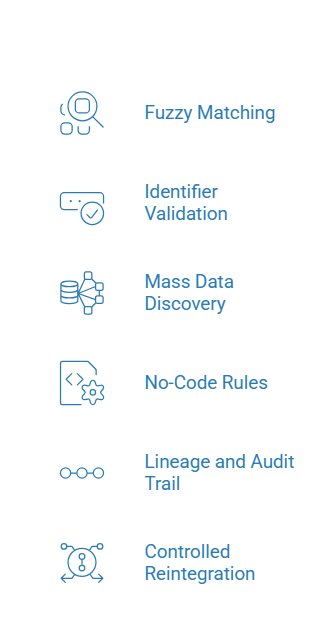
Not every data quality platform handles supplier identity resolution well. The capabilities that matter most are:
- Fuzzy and phonetic matching, with a confidence score rather than a strict exact-match rule.
- Country-specific identifier validation — SIRET and SIREN for France, equivalent checks for other jurisdictions.
- Mass data discovery across ERPs, databases, files, and regional systems, not just the primary procurement tool.
- No-Code rule management, so procurement and finance teams can adjust matching thresholds without depending on IT.
- Lineage and audit trail for every merge, so a reviewer can see which records were combined and why.
- Controlled reintegration back into source systems, rather than a one-off export.
Without governed matching and reintegration, supplier data tools risk becoming another point-in-time cleanup rather than a standing control layer.
Supplier Data Quality Checklist
A quick way to assess where you stand:
- Are supplier records duplicated across systems?
- Are VAT, SIRET, SIREN, or other tax IDs complete and valid?
- Are bank details up to date and independently verified?
- Are parent-child supplier relationships documented?
- Are inactive or defunct suppliers flagged rather than left active?
- Are new suppliers checked against existing records before creation?
- Is every merge documented with a clear audit trail?
- Can corrected supplier data be reintegrated into source systems automatically?
If several of these answers are unclear, the issue is not only supplier data quality. It is a sign that your organization may still be relying on periodic cleanup instead of continuous supplier master data management.
Where Tale of Data Fits
Tale of Data brings supplier identity resolution into a single No-Code workflow, built so procurement and finance teams can own the rules without depending on IT for every change.
Concretely, that means scanning ERPs, databases, files, and regional systems to map where supplier data actually lives; detecting duplicates through fuzzy matching with a confidence score; validating SIRET, SIREN, and VAT identifiers automatically as records are entered; applying business rules that procurement and finance teams define themselves in plain language; documenting every correction with a full audit trail; reintegrating corrected records back into source systems with complete lineage; and monitoring the supplier file continuously, rather than waiting for the next periodic cleanup.
The platform does not replace existing procurement or ERP systems. It sits upstream of them as the layer that keeps the supplier file trustworthy over time.

Data Migration from Legacy Systems: Risks & Checklist

Data Cleansing Services vs. Software: What to Choos