

How Data Quality Determines Business Intelligence Performance
Why Data Quality Is the Foundation of Business Intelligence Decisions
In large organizations, Business Intelligence has become a pillar of strategic management, financial reporting and operational decision-making. Behind every dashboard and every indicator lies an implicit assumption: that the data is reliable.
But this assumption is increasingly fragile.
As BI gains in importance, data quality is no longer a technical issue, but a direct factor in performance, compliance and risk management. When the figures are credible, decisions are made quickly and confidently. When they are not, dashboards become objects of debate rather than tools for action.
Despite widespread awareness, many data quality initiatives are still struggling to get beyond the pilot stage. The tools exist, the skills are available, but in complex information systems, scaling data quality sustainably for BI remains a major challenge.
This challenge is not primarily a technological one. As soon as data quality is automated and made visible, it becomes traceable, explicable and enforceable. It then moves beyond the traditional boundaries of IT to directly affect the organization's decision-making, financial and regulatory issues.
📘 White paper

It is precisely this tipping point that we have chosen to analyze in greater depth in our white paper dedicated to Business Intelligence performance. It offers a structured reading framework for understanding why data quality is becoming a decision-making issue in its own right, and how to restore lasting confidence in BI uses, beyond one-off fixes.
When Poor Data Quality Becomes a Business and Regulatory Issue
The consequences of poor data quality are not theoretical.
At Unity Technologies, a failure in the data feeding the analytical models led to an estimated loss of $110 million and a significant fall in the share price. At Equifax, data errors led to erroneous credit scores, triggering regulatory pressure and legal action. At Citigroup, persistent shortcomings in governance and data quality led to repeated sanctions of several hundred million dollars.
These situations illustrate a common reality: when data quality is not managed at the source, the impacts extend far beyond BI to affect the organization's performance, compliance and credibility.
Why Poor Data Quality Breaks Business Intelligence
Business Intelligence is based on trust. An indicator only has value if it can be understood, explained and defended.
The first signs of deterioration are often subtle:
- inconsistencies between reports intended to reflect the same business reality,
- unexplained variations in key indicators,
- figures that no longer correspond to business intuition.
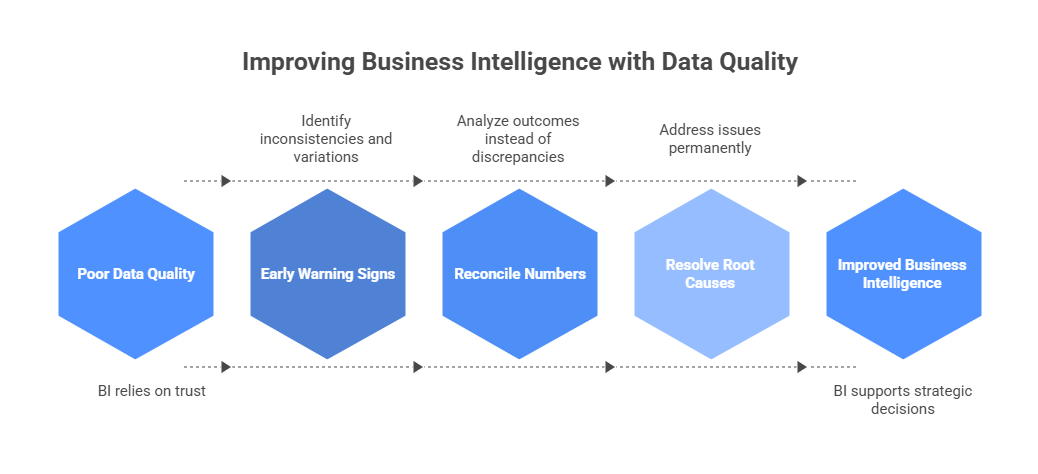
The role of BI then changes. It is no longer used to make decisions, but to justify discrepancies. Teams spend more time reconciling figures than analyzing results. Local corrections multiply, technical debt increases, and root causes are never addressed.
As BI supports strategic or regulated decisions, this fragility becomes an operational and legal risk.
Restoring Reliable BI Requires Industrialized Data Quality
Fixing data issues on a one-off basis is not enough. To sustainably restore the value of BI, data quality must be managed as a structured, ongoing process.
Applied to BI, Data Quality Management aims to ensure that the data used to drive the business can be understood, explained and audited over time. This implies explicit rules, clear responsibilities and permanent control mechanisms.
Business users play a key role here. Given the right tools and a governed framework, they can actively contribute to defining rules and validating corrections. This collaboration strengthens data ownership and speeds up problem resolution, without compromising governance.
📘 White paper
The white paper explains how to structure this collaboration between business, IT and data teams, while maintaining traceability and control.
Why an Independent Data Quality Platform Is Essential
Dealing with data quality solely within BI tools leads to fragmented corrections. Problems are detected late, corrected locally and rarely documented consistently.
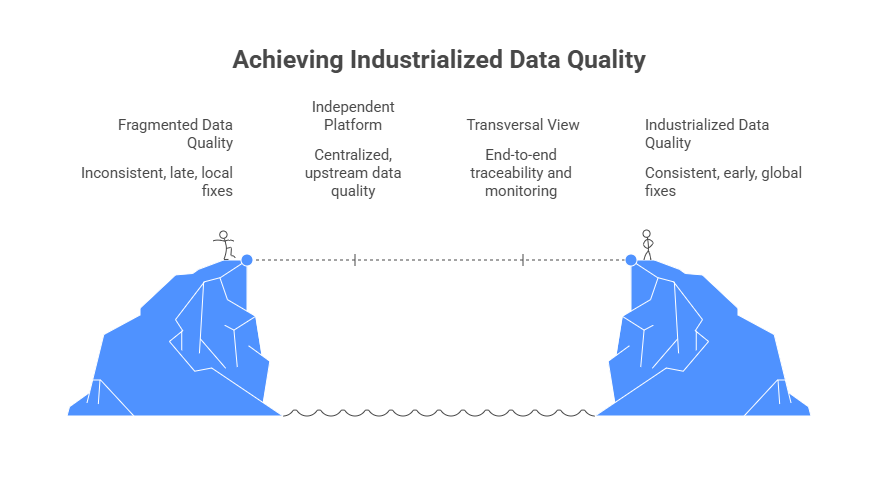
An independent Data Quality platform enables you to act upstream, as close as possible to the source, and distribute reliable data to all BI applications. It provides a cross-functional view, full traceability and continuous monitoring capabilities, essential for industrializing data quality at scale.
Conclusion: From Questionable Dashboards to Truly Decision-Ready BI
Business Intelligence doesn't fail for lack of tools, data or analytical sophistication. It fails when confidence is lost. As BI becomes a strategic, financial and regulatory lever, tolerance for data ambiguity collapses. Indicators must not only be readable, but explainable, traceable and defensible.
Successful organizations don't just correct dashboards or improve the reliability of individual indicators. They treat data quality as a corporate capability, rooted in decision-making practices, shared between the business, IT and data teams, and industrialized across the entire information system.
This approach allows us to move away from a defensive logic - based on manual validations and a posteriori justifications - to build a truly decision-ready BI, capable of supporting performance, compliance and automation with complete confidence. In a context where data-driven decisions are increasingly scrutinized, data quality is becoming a sustainable competitive advantage.
📘 White paper

The white paper takes this transformation a step further, proposing a pragmatic approach to restoring trust, reducing risk and turning Business Intelligence into a true decision-making asset, even in complex environments.

Financial Data Quality Management: Framework, Risks and Best Practices

Why Data Quality Is Essential for Agentic AI
