
Download your exclusive document
Is Your Pharma Data Ready for Audits, AI and Critical Operations?
Download the self-assessment guide to evaluate data quality, traceability and audit-readiness across product, material, supplier and clinical data before issues impact audits, submissions, migrations, reporting or AI initiatives.
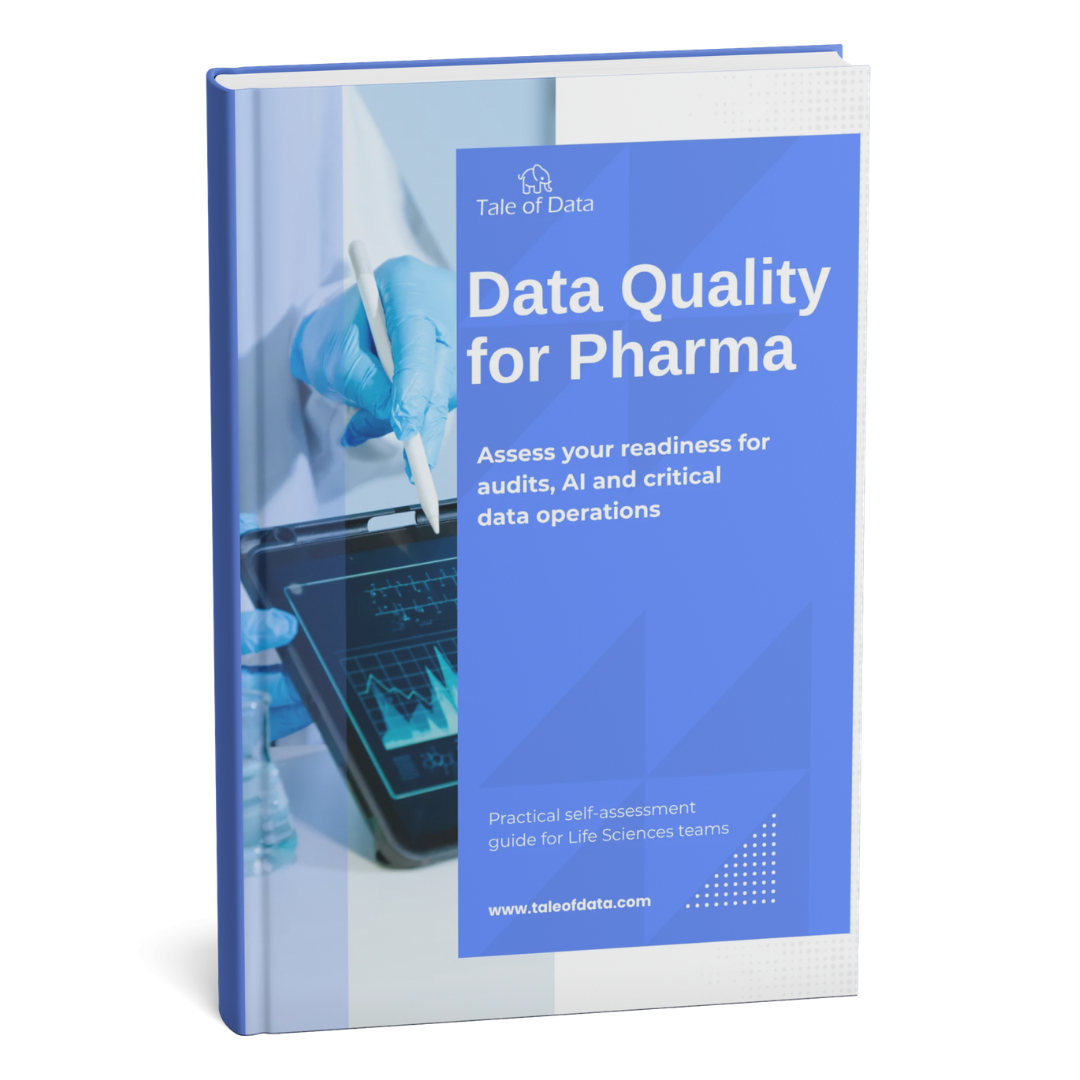
Data Quality for Pharma: Self-Assessment Guide
Download the guide to assess your data quality maturity across four critical areas: product, material and supplier master data, clinical trial data quality, clinical data integration, and cross-system data integrity.
Inside the guide, you will find a 20-question self-assessment, a practical explanation of ALCOA+ principles, a scoring framework to identify your highest-risk areas, and a 5-step method to build more trusted, traceable and AI-ready data pipelines.
Identify where your pharma data becomes fragile
Many pharma data quality issues are not caused by core systems alone. EDC, LIMS, QMS, ERP, CTMS, RIM and pharmacovigilance platforms may be controlled within their own perimeter, but data often becomes fragile when it moves between them.
Exports, scripts, staging tables, supplier files, clinical extracts, spreadsheets and manual reconciliation steps can create hidden risks: duplicate suppliers, inconsistent product codes, missing fields, undocumented transformations, weak lineage or clinical data reconciliation gaps.
When these issues are discovered late — before an audit, during a migration, before database lock, or when an AI project needs reliable inputs — teams are forced into urgent remediation under pressure.
This guide helps your team identify these risks earlier, score your current maturity and decide where to focus first.
Get your free copy
What the Guide Covers
The Data Quality for Pharma guide helps life sciences teams assess where critical data becomes fragile and where to focus first.
It covers the four areas where data quality risks most often appear:
Product, Material & Supplier Master Data readiness
Product identifiers · API and material consistency · supplier deduplication · cross-system discrepancies · master data monitoring.
Clinical Trial Data Quality readiness
Critical data points · EDC/LIMS/ePRO reconciliation · documented transformations · clinical data quality monitoring · explainable preparation steps.
Clinical Data Integration readiness
Clinical system mapping · integration pipelines · embedded quality controls · identifier reconciliation · protocol and vendor format changes.
Cross-System Data Integrity & Governance readiness
Lineage · documented corrections · business-user remediation · data quality monitoring · explainable data preparation processes.
Built for Life Sciences Data, Quality and Business Teams
This guide is designed for teams working with critical pharma data across existing systems.
It is especially useful for:
Data leaders preparing AI, reporting or analytics initiatives
Quality teams looking for more traceable preparation processes
Clinical data teams managing multi-source datasets
IT and data teams responsible for integration pipelines
Business teams working with product, supplier or material master data
Life sciences organizations preparing migrations, audits or data governance initiatives
The guide does not replace regulatory, quality or validation expertise. It helps teams identify where data preparation, traceability and quality controls need to be strengthened before downstream use.
How Tale of Data Helps SAP Migration Teams
Tale of Data is a no-code Data Integration platform with data quality built into every pipeline.
We help life sciences teams connect, transform, validate, deduplicate, document and monitor critical data in the preparation layer around existing systems — without replacing EDC, LIMS, CTMS, QMS, ERP or pharmacovigilance platforms.
With Tale of Data, teams can run a Flash Audit on structured exports, files, staging tables or accessible datasets to identify completeness gaps, duplicate rates, format issues, identifier mismatches and traceability weaknesses before deciding what to fix first.
Instead of relying on fragile scripts, manual checks or late-stage remediation, Tale of Data helps teams build trusted data pipelines where quality controls, lineage and monitoring are built into the flow.
Frequently Asked Questions
This guide helps life sciences teams assess their data quality maturity across product, material, supplier and clinical data. It is designed to identify where critical data becomes fragile, especially when it moves between systems.
The guide is intended for data, quality, IT and business teams in pharmaceutical, biotech, medtech and life sciences organizations. It is especially relevant for teams preparing audits, migrations, submissions, reporting, AI initiatives or data governance projects.
No. This guide is not a regulatory, quality or validation document. It is a practical self-assessment tool focused on data quality, traceability and preparation processes around existing systems.
The self-assessment includes 20 questions across four domains: master data, clinical trial data quality, clinical data integration and cross-system data integrity. It helps teams identify their highest-risk areas and prioritize the next actions.
No. Tale of Data does not replace validated or specialized pharma systems. It operates around them, helping teams qualify the data that feeds downstream systems, dashboards, migrations and AI initiatives.
The Flash Audit gives teams a fast, documented view of data quality risks in a structured export, file, staging table or accessible dataset. It helps identify duplicates, missing values, format issues, identifier mismatches and traceability weaknesses before remediation begins.
Related Resources

SAP Data Migration
Broad overview of the SAP migration process — approaches, tools, risks, and where data quality fits.

SAP Data Migration Best Practices
The 10 data quality checks to validate before cutover — with context and domain-by-domain explanations.

Data Quality Management SAP
How to operationally manage SAP data quality before migration — tool comparison and approach selection.
Let's talk data. Contact our experts
Discuss your data issues and find out how our solutions can make a real difference.